
Posts

Cash Transactions vs. Financing in the 2026 Tahoe Luxury Market

Cash Transactions vs. Financing in the 2026 Tahoe Luxury Market

In the 2026 Lake Tahoe luxury market, a buyer’s method of payment reveals more than whether a lender is involved. It can signal liquidity, risk tolerance, portfolio strategy, timing pressure, and the buyer’s confidence in a particular property.


For sellers, however, the most important question is not simply, “Is this a cash offer?” It is:

Which offer delivers the strongest combination of price, certainty, timing, and acceptable risk?


That distinction matters in Tahoe because the market is highly segmented. A $2 million second home, a $6 million Martis Camp residence, and a $20 million Nevada lakefront estate do not draw the same buyer pool or follow the same financing patterns. The higher and more irreplaceable the property, the more liquidity tends to shape the transaction—and the less useful broad housing-market averages become.

The Cash-Versus-Financing Ratio: What the Data Can (and Cannot) Tell Us

The most responsible reading of the 2026 data begins with a limitation: publicly released Tahoe market summaries do not provide one verified, basin-wide ratio of cash purchases to financed purchases in the luxury tier. They report price bands, closed sales, volume, median prices, and days on market, but not a complete payment-method field. Quoting a precise “Tahoe cash percentage” without transaction-level deed or loan records would therefore overstate what the public data establishes.


What the reports do show is a market with a substantial concentration of high-value transactions. Through June 30, 2026, the Tahoe–Truckee–Incline Village region recorded 482 residential sales. Of those, 106—or 22%—closed above $2 million; 31 closed above $5 million; and 10 closed above $10 million. A separate midyear analysis found that 54 of 85 Incline Village and Crystal Bay single-family sales, or 64%, exceeded $2 million, while 17 exceeded $5 million. Every one of the 10 reported lakefront sales closed above $5 million.


Those figures do not identify payment type, but they do establish the size of the buyer-liquidity question. Tahoe is producing enough high-dollar closings that sellers should expect a meaningful mix of outright cash, jumbo mortgages, portfolio loans, private-bank financing, and buyers who can remove a financing contingency even if they choose to borrow after closing.

2026 market lensCashFinancedWhat sellers should conclude
Tahoe luxury, basin-wideNot publicly reportedNot publicly reportedRequire property- and submarket-specific analysis rather than relying on an unverified headline ratio.
All U.S. sales, Q1 2026 (ATTOM)41.7%58.3%Cash remains important nationally, although this includes every price tier and is not a Tahoe proxy.
40 large U.S. metros, March 2026 (Redfin)28.8%71.2%Different datasets produce different totals; Redfin counts a sale as cash when no mortgage appears on the deed.
$1M–$2M luxury example highlighted by Realtor.com46.5%53.5%Entry luxury can still contain a slight financing majority.
$2M–$5M luxury example highlighted by Realtor.com64.4%35.6%Cash becomes more prevalent as price rises.
$5M–$10M luxury example highlighted by Realtor.com84.7%15.3%At the upper end, the available buyer pool can be overwhelmingly liquid.
Above $10M luxury example highlighted by Realtor.com60.9%39.1%Complex wealth and ownership structures can make financing strategic rather than necessary.

Realtor.com cited the price-tier percentages in the final four rows from National Association of REALTORS® data while discussing Miami as an example of a major luxury market. They are not Tahoe statistics. They are useful because they illustrate a broader liquidity curve: cash usage generally rises with price, but it does not increase in a perfectly straight line.

Why a Financed Luxury Offer May Still Represent Substantial Liquidity

In the conventional market, financing often reflects what a buyer can afford. In the luxury market, financing may instead reflect how a buyer prefers to allocate capital.


A high-net-worth buyer may use a jumbo mortgage, a portfolio loan, or a private-bank facility to avoid liquidating concentrated stock, creating a taxable event, or removing capital from other investments. Goldman Sachs notes that wealthy buyers often borrow strategically to preserve liquidity, optimize investments, and maintain financial flexibility. Portfolio mortgages can also offer customized qualification and privacy features for high-value properties.


That means sellers should avoid two common mistakes. The first is assuming that every cash buyer is financially stronger than every financed buyer. The second is assuming that a financed buyer is highly sensitive to the monthly payment.


The 2026 baseline conforming loan limit is $832,750, with a one-unit ceiling of $1,249,125 in qualifying high-cost areas. Most Tahoe luxury purchases therefore require either significant equity or nonconforming financing. A buyer seeking a $3 million loan may have extensive verified assets and a long private-banking relationship, even though a loan appears in the offer.


Rates still influence behavior. Freddie Mac’s national average for a 30-year fixed conforming mortgage was 6.76% for the week of September 10, 2026, up from 6.35% one year earlier. This is not a Tahoe jumbo rate, but it helps explain why buyers who can avoid conventional borrowing may choose to do so. It also explains why some highly liquid buyers finance selectively rather than automatically.

What Cash Changes in a Tahoe Negotiation

Cash can improve an offer in four practical ways. It can eliminate a loan contingency, reduce appraisal exposure, shorten the closing timeline, and lower the risk that a lender’s underwriting decision disrupts the transaction.


Those advantages have value, but they do not have unlimited value.


A seller should not automatically accept a materially lower price just because it is attached to proof of funds. The correct decision depends on the spread between offers, the buyer’s diligence requests, the proposed closing date, the strength of the deposit, and the consequences if the transaction fails.

Offer characteristicSeller advantageQuestion to verify
All cash with current proof of fundsHigh certainty and fewer third-party conditionsAre the funds liquid, accessible, and sufficient for the purchase and closing costs?
Financing with no loan contingencyBuyer may preserve capital without transferring lender risk to the sellerCan the buyer close from other assets if the loan is delayed or denied?
Financing with an appraisal contingencyMay support a higher nominal priceWhat happens if the appraisal is below contract price?
Fast closeReduces market exposure and carrying timeDoes speed benefit the seller’s move, tax planning, or replacement purchase?
Longer close with stronger economicsMay produce a higher net resultIs the added price worth the additional execution and timing risk?

In other words, cash is a term—not a verdict. A clean $5.8 million cash offer may be superior to a $6 million financed offer with broad contingencies. A fully underwritten $6 million financed offer with a meaningful deposit and verified reserves may be stronger than a $5.8 million “cash” offer whose funds are not yet liquid.

Liquidity Strengthens Sellers Most When the Property Is Scarce

Cash alone does not create seller leverage. Competition for an irreplaceable property creates leverage. Liquidity determines how quickly qualified buyers can act on that competition.


The first half of 2026 demonstrated this distinction. Ten lakefront homes in the reported California-and-Nevada segment sold through June, compared with four in the same period of 2025. Lakefront sales volume increased 150%, the median price rose 49%, and average days on market fell 41%. One Glenbrook property sold for $22.15 million after receiving multiple offers within a week and closed $2.65 million above asking price.


That is the environment in which cash becomes most powerful: several capable buyers recognize that the same combination of frontage, views, pier rights, privacy, or Nevada-side location may not be available again soon.


Yet sellers should not apply trophy-property logic to every listing. Across the broader Tahoe–Truckee region in July, approximately 29% to 31% of active listings had already received at least one price reduction, with an average reduction of 6.8%. Even an affluent buyer pool remains disciplined when a property is replaceable or its asking price is disconnected from recent evidence.


Liquidity can accelerate a correctly positioned sale. It does not rescue aspirational pricing.


What Today’s Buyer Profile Means for Tahoe Sellers

The 2026 luxury buyer is not one-dimensional. Coldwell Banker Global Luxury reported that 63% of surveyed Luxury Property Specialists saw an increase in all-cash purchases among luxury clients, up from 51% one year earlier. The same report described a widening “liquidity line”: ultra-high-net-worth buyers were accelerating purchases, while buyers immediately below that tier were more likely to wait for rate or economic clarity.


We see three implications for Tahoe sellers.


First, the top of the market may be less rate-sensitive, but it is not less sophisticated. Liquid buyers still scrutinize value, title, insurability, condition, shoreline rights, permits, and future usability. They can move quickly precisely because they have the resources and advisory teams to evaluate risk efficiently.


Second, financed buyers should be graded by execution strength rather than by loan status alone. A private-bank borrower with substantial reserves may present less risk than a nominal cash buyer who needs to sell securities, move funds between entities, or unwind another transaction before closing.


Third, the seller’s negotiation strategy should change by tier. In the $2 million to $5 million range, carrying costs and rate sensitivity may have more influence. Above $5 million—and especially for scarce lakefront and Nevada-side properties—the discussion increasingly centers on uniqueness, privacy, lifestyle, and long-term asset value.


The David Morris Group Seller Playbook

For a luxury listing, we recommend preparing to evaluate the buyer’s entire capital position—not simply the box checked next to “cash” or “financing.”


Before launch, pricing should be calibrated to the property’s true competitive set. Tahoe is not one market. Incline Village, Crystal Bay, Glenbrook, the East Shore, the California North and West Shores, Truckee, and private resort communities each have distinct demand and liquidity patterns.


The property should also be made easy to underwrite. A well-organized diligence package can include title information, permits, surveys, insurance history, homeowners’ association documents, utility records, and documentation for piers, buoys, defensible space, or major improvements where applicable. Certainty attracts decisive buyers.


When offers arrive, the comparison should focus on net proceeds, contingency exposure, verified liquidity, deposit strength, closing timing, and the buyer’s ability to perform. Proof of funds should be current and specific enough to support the offer. A financed buyer’s lender, underwriting status, loan structure, appraisal plan, and reserve position should be examined with equal care.


Finally, concessions should be priced rather than assumed. If a cash buyer requests a discount for speed and certainty, the seller should quantify what that certainty is actually worth. If a financed buyer offers more, the seller should quantify the added risk. This is where experienced representation turns an attractive headline price into a reliable closing.


Our Perspective

The 2026 Tahoe luxury market is best understood as a liquidity-stratified market. The higher the price and the rarer the property, the more likely buyers are to possess the resources to transact without conventional financing. But visible financing does not necessarily indicate financial constraint, just as a cash label does not guarantee perfect execution.


For sellers, the practical advantage is clear. A deeply liquid buyer pool can reduce rate sensitivity and support decisive action on exceptional properties. The strategic challenge is equally clear: the strongest offer is the one that converts buyer capacity into the best risk-adjusted result.


The David Morris Group brings in-depth knowledge of Reno, Sparks, Incline Village, and the greater Lake Tahoe market, along with strategic marketing and focused negotiation. If you are considering selling a luxury property, we can prepare a property-specific analysis of recent comparable sales, buyer depth, pricing, and the terms most likely to protect your leverage.

Contact The David Morris Group Today
📞 (775) 828-3292
✉️ [email protected]
🌐 DavidMorrisGroup.com

This article is for general market information only. It is not legal, tax, lending, or investment advice. Market statistics are subject to revision, and definitions of “luxury” vary by source and submarket.


Price-Per-Square-Foot Realities: The Metrics Defining Incline Village vs. South Reno

Price-Per-Square-Foot Realities: The Metrics Defining Incline Village vs. South Reno

When evaluating high-end properties, buyers often look for a simple metric to gauge value. It’s tempting to divide the asking price by the interior footprint and use the resulting number to compare homes across different neighborhoods. However, relying solely on this basic division equation is a flawed strategy. True market intelligence requires moving beyond generic comparisons and analyzing the hard data behind price-per-square-foot variations. In the complex Nevada luxury market, understanding how construction quality, lot size, and location premiums translate into tangible numbers is the only way to ensure your investment yields the highest structural value. 

The Baseline Data and Why It Can Mislead

To understand the variations between Incline Village and South Reno, we first have to look at the regional baselines. The raw data provides a snapshot, but it doesn’t tell the whole story.

  • According to recent Redfin data, the median sale price per square foot in Incline Village sits at $765, reflecting a 7.7% year-over-year increase.
  • In contrast, the broader Reno citywide median sale price per square foot is significantly lower at $334.
  • However, South Reno operates in a distinct, higher-tier category compared to the citywide average; Zillow’s Home Value Index tracks the average South Reno home value at over $1.05 million.

The problem with these median figures is that they blend everything together. A $400,000 aging condominium and a $4 million custom estate are thrown into the same statistical bucket. For luxury buyers, this means the median price per square foot is rarely reflective of the actual high-end properties they’re considering.

The Location Premium

A significant portion of a property’s price isn’t tied to the structure at all; it’s dictated by the dirt it sits on. Incline Village commands a substantially higher baseline because of strict land scarcity. The Tahoe Regional Planning Agency (TRPA) heavily regulates new development in the basin, meaning there’s a finite supply of housing. You aren’t just paying for the house; you’re paying a premium for a Lake Tahoe address and the exclusive community amenities that come with it.


South Reno, while highly desirable and experiencing rapid growth in its luxury sectors, doesn’t face the same absolute geographic constraints. While premium lots in gated communities carry their own significant value, the relative availability of developable land compared to the Tahoe basin naturally results in a different price-per-square-foot baseline.

Construction Quality and Structural Value

Square footage math assumes all square feet are created equal. In the luxury tier, this couldn’t be further from the truth. The cost to build, and therefore the structural value, varies wildly based on execution.

  • Custom Engineering: Homes in Incline Village often require specialized engineering to handle heavy snow loads, steep grading, and strict environmental compliance, driving up the intrinsic cost per foot.
  • Material Selection: A 4,000-square-foot production home with standard builder-grade finishes in a newer South Reno subdivision will inherently carry a lower price per foot than a 4,000-square-foot custom architectural masterpiece utilizing imported stone, custom millwork, and commercial-grade appliances.
  • Appraisal Realities: Official appraisal standards, such as those outlined by Fannie Mae, explicitly warn against using arbitrary per-square-foot adjustments. Appraisers are required to adjust for differences in quality of construction and property condition because the market reacts to these tangible differences, not just the raw size of the home.

Lot Size and the Unmeasured Variables

Perhaps the biggest flaw in the price-per-square-foot metric is that it only measures the interior living space. It completely ignores the exterior parcel.

  • A home sitting on a flat, fully landscaped half-acre in a South Reno gated community offers a completely different lifestyle value than a home on a steep, quarter-acre forested lot in Incline Village.
  • The price-per-square-foot calculation assigns zero value to expansive outdoor living spaces, custom hardscaping, panoramic views, or privacy buffers.
  • When you divide the total purchase price by the interior square footage, you are artificially inflating the “cost” of the house by rolling the value of the land and exterior amenities into the interior measurement.

Ultimately, price per square foot is a useful screening tool, but it shouldn’t dictate your final purchasing decision. By analyzing comparable sales that account for location, quality, and site characteristics, buyers can make truly informed decisions based on real structural value.

Final Thoughts

Understanding the nuances of local real estate metrics requires more than just a passing glance at an algorithm’s estimate. It demands a deep understanding of local challenges, from strict building regulations in the Tahoe basin to the specific maintenance requirements of high-elevation properties. Consistent maintenance and a clear-eyed view of what drives property values are essential for protecting your investment.


Don’t let concerns over complex market data or confusing metrics hold you back from finding your ideal luxury property. The key is having a trusted REALTOR® who can translate raw data into actionable market intelligence. The David Morris Group is your local expert in the Reno, Sparks, and Incline Village luxury markets. With our deep analytical knowledge, personalized guidance, and unwavering commitment to our clients, we ensure you understand exactly where your investment yields the highest return. We invite you to schedule a free consultation with us today to discuss your unique real estate goals.


At The David Morris Group, we do not just know the market. We know the lifestyle.

Contact The David Morris Group Today
📞 (775) 828-3292
✉️ [email protected]
🌐 DavidMorrisGroup.com

David Morris Group - Is the Housing Market Cooling_ Real Estate Predictions for Fall - Reno Real Estate Market - Fall 2021 Housing Market Predictions - Reno Nevada Housing Market

Is the Housing Market Cooling? Real Estate Predictions for Fall

David Morris Group - Is the Housing Market Cooling_ Real Estate Predictions for Fall - Reno Real Estate Market - Fall 2021 Housing Market Predictions - Reno Nevada Housing Market

The past year and a half has brought all eyes to the real estate market. With inventory levels depleting quickly, days on the market shortening, and multiple offers coming in above asking price, the market was extremely competitive. Now that summer has come to an end, everyone’s asking, “is the housing market cooling?” Take a look at the real estate predictions for fall.

What are experts saying across the nation?

Over the course of the fall season, it’s expected that the real estate market will begin to cool across the nation. It’s also expected that we’ll be back to experiencing the normal seasonality of the market, with spring and summer bringing more homes and buyers to the market, while the fall and winter months will bring only serious buyers and sellers to make a transaction.


With the market cooling also comes more homes on the market and less competition as some may only have a moving window in the spring and summer months. Buyers will have more options to choose from in their price range, homes aren’t flying off the market as quickly as they’re put on, and seeing bidding wars between buyers for thousands of dollars above asking price is less common.

What are we actually seeing across Washoe County?

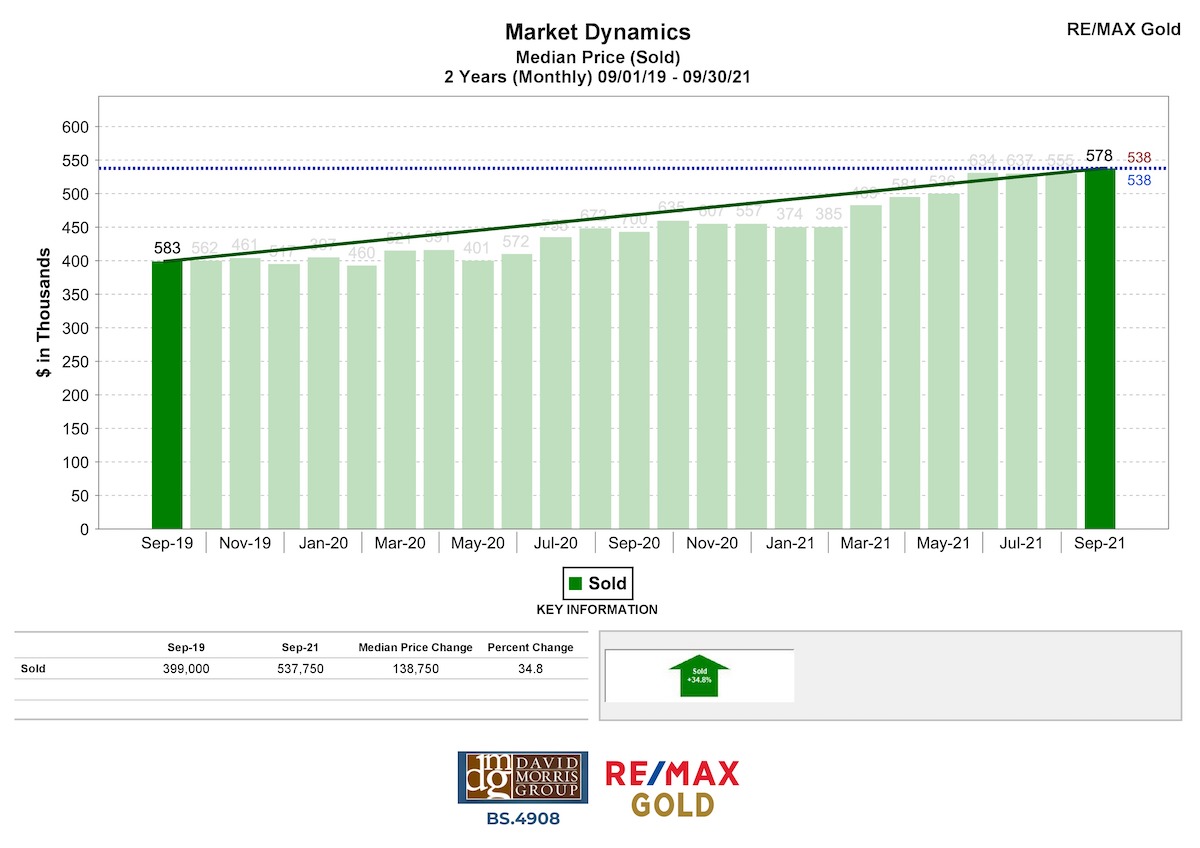
While we’d love to tell buyers that there has been an immediate cooling to the market, it’s still a very competitive market. The median sold price of homes in Washoe County in September 2021 was $537,750, an increase of 34.8% since September 2019, and it doesn’t look like home prices will be falling anytime soon. In September, the number of homes for sale decreased 48.3%, the number of homes sold decreased .9%, and the number of homes that went under contract increased 14.8% from this time two years ago. Inventory levels are holding at one month, which is a drastic change from the 3.4 months of inventory on the market in September 2019.


If September is any indication of what we should expect from the rest of the fall season, we may experience a slight cooling to the real estate market, but with inventory levels remaining low and demand still remaining high, it’s likely that Reno will be a hot market to watch in the coming months.


If you’re curious about the Reno real estate market and how it’s changing, contact the David Morris Group. We’re happy to be your Reno resource, and if you’re hoping to buy or sell a home in the coming months, we’re happy to help you navigate the fast-moving market. Give us a call at (775) 828-3292.


David Morris Group - Navigating the Hot Reno Market - 2021 Reno Real Estate Market - Reno Sparks Real Estate Market - 2021 Sellers Market

Navigating the Hot Reno Market

David Morris Group - Navigating the Hot Reno Market - 2021 Reno Real Estate Market - Reno Sparks Real Estate Market - 2021 Sellers Market

The real estate market continues to change, but the last year has brought unforeseen highs and lows to the Reno market. The current seller’s market may add new challenges and obstacles for buyers and new opportunities for sellers. Let’s take a look at the current market and how to navigate it.

Record Low Supply

Inventory levels normally hover at a couple of months, but these days, inventory levels are hovering at a few weeks. Fewer homes are on the market has highlighted the shortage of homes in Northern Nevada and the nation. The recession brought the home building industry close to a stand-still, limiting the houses on the market.

High Demand

That low supply level is being matched by a high demand. With more people working from home, the pandemic highlighting new wants and needs in a home, and low interest rates, more buyers are searching for homes. We’re seeing more people looking to relocate to Nevada to take advantage of the tax benefits, beautiful weather, great employment opportunities, and variety of amenities that Reno has to offer.

More Refinancing

Record low interest rates have incentivized potential sellers to stay in their current homes and refinance their mortgages to capitalize on those low interest rates.

Navigating the Market

The hot market means that it’s more important for buyers to be prepared. Buyers should:

  • Get prequalified. You need to know how much house you can afford to buy before you start looking.
  • Make a strong offer. If you come in with an offer below asking price, it’s likely you’ll be outbid, and your offer won’t be considered.
  • Have extra cash ready. Homes are going above asking price and above appraisal values. Having the money to cover the difference is imperative to getting to the closing.
  • Hire a real estate professional who has the necessary experience and negotiation skills to advocate on your behalf in a challenging market. You must have someone who knows this market and knows how to structure an attractive offer that has the best chance of being accepted by a seller in a multiple offer situation.

The hot market also means that it’s a great time for sellers to capitalize on the market. Sellers should:

  • Be prepared for multiple offers. It’s likely that your home will create a bidding war amongst buyers.
  • Review each bid with your agent to determine which one is the best fit.
  • Move quickly. Some buyers prefer a quick closing, so be prepared for things to move quickly after accepting an offer and closing on a home.

The seller’s market is moving quickly, and if you need help navigating the hot Reno market, contact the David Morris Group. We’re here to offer our expertise, and we’ll be by your side every step of the way–give us a call at 775.828.3292.


David Morris Group - New Year's Resolutions to Make Your House a Better Home - Best Reno Real Estate Broker - Best Reno Realtors - Reno Homes - Reno Real Estate

New Year’s Resolutions to Make Your House a Better Home

David Morris Group - New Year's Resolutions to Make Your House a Better Home - Best Reno Real Estate Broker - Best Reno Realtors - Reno Homes - Reno Real Estate

2021 will be here in the blink of an eye, and while we can’t believe that 2020 has passed by already, it is once again time to make resolutions and goals for the new year. If your 2020 resolutions have more than a few things you couldn’t check off thanks to a global pandemic, make a few goals that you can achieve no matter what the year holds. Check out the New Year’s resolutions to make your house a better home.

Minimize energy use

With more time spent at home comes more energy used and higher utility bills. Take time to find ways you can cut costs. You can start by:

  • Unplugging appliances when they’re not in use.
  • Hang curtains to keep your home cooler in the summer.
  • Open blinds during the day to use natural light to brighten your home rather than light fixtures.
  • Add a timer to control how long your lights stay on.
  • Switch to energy-saving light bulbs.

Create a cleaning schedule and stick to it

Keeping a tidy home can be overwhelming, especially if you find that your weekends are consumed with deep cleaning. There may be some areas of your home that you’re overcleaning and some areas of your home that you’re neglecting. Create daily tasks that will help you maximize your time and keep your home tidy at all times.

Take on one DIY project a month

If you’re tired of the furniture in your home or you want to spruce up your space without breaking the bank, research a few DIY projects that you may want to try and put them into action. Trying something new and adding some sweat equity into your home can help you love your space.

Try seasonal trends

Home design is a lot like fashion — the trends change quickly and often seasonally. Research the latest home design trends and try them out in your home. It can be a simple change that you don’t spend a lot of time or money on, but it may open your eyes to new styles, colors, and themes that you like and may want to continue in your home.

Focus on your outside space

Your outdoor space is as much a part of making a house a home as the interior space is. Reno has beautiful seasons, and it’s important to have an outdoor area where you can spend time soaking up the sun, breathing in the fall air, and cuddling up by a fire pit in the brisk evenings. Think about investing in outdoor furniture, hammocks, a projector for outdoor movie nights, etc. Make it a fun and usable space.


If you’re in need of more New Year’s resolutions to make your house a home or you’re simply curious about the Reno-Sparks real estate market, contact the David Morris Group. Give us a call at (775) 828-3292.


David Morris Group - The Latest Construction Projects Around Reno and Sparks - Best Reno Real Estate Broker - Best Reno Realtors - Reno Homes - Reno Real Estate

The Latest Construction Projects Around Reno and Sparks

David Morris Group - The Latest Construction Projects Around Reno and Sparks - Best Reno Real Estate Broker - Best Reno Realtors - Reno Homes - Reno Real Estate

Just as many of us have been using the time at home to build new skills, take on new projects, and think outside the box, the city of Reno has been doing the same. The future of Reno looks bright, and it’s partly because of some exciting developments that are on the horizon. Check out the latest construction projects around Reno and Sparks.

Reno City Center

The former Harrah’s casino is a part of a new project to turn downtown Reno into a place where live, work, and play culminate perfectly. The west tower isn’t slated to wrap for another two years, but when finished, it will include apartments, retail space, and public green space.

Keystone Commons

With financing secured, Keystone Commons has begun rolling forward on construction for the parking garage, four-story apartment building, and retail space. Some of the brands that have leased space in the upcoming development include In-N-Out Burger and Starbucks.

The Oddie District

The former Lowe’s building in Sparks is currently the site for a $30 million work-live development. It will feature 40,000 square feet set aside for a maker space component and 60,000 square feet set aside for “flex-tech” spaces that can double as living quarters. The massive project has also set aside 9,000 square feet for small businesses, 10,000 square feet for restaurants, and 8,000 square feet for a brewery/distillery.

Swope Middle School

In an effort to help alleviate any overcrowding, Swope Middle School is undergoing some construction to add a new gym, new classrooms, and new HVAC systems throughout the school. Construction is expected to finish by 2022.

T3

There’s some new momentum to report for the T3 development. Permits for a five-story apartment complex and a five-story parking garage have been submitted. There are also plans for retail and green space, but progress hasn’t started on those projects yet. With a completion date in 2023, this development will be one to watch out for in the coming years.


If you’re curious about any of the latest construction projects around Reno and Sparks or you’re simply curious about the Reno-Sparks real estate market, contact the David Morris Group. Give us a call at (775) 828-3292.